What is Header Bidding?
Header bidding has revolutionized programmatic advertising by enabling publishers to receive bids from multiple demand sources simultaneously before making ad server calls. Unlike the traditional waterfall model where ad networks bid sequentially, header bidding creates a unified auction environment that typically results in higher CPMs and increased fill rates.
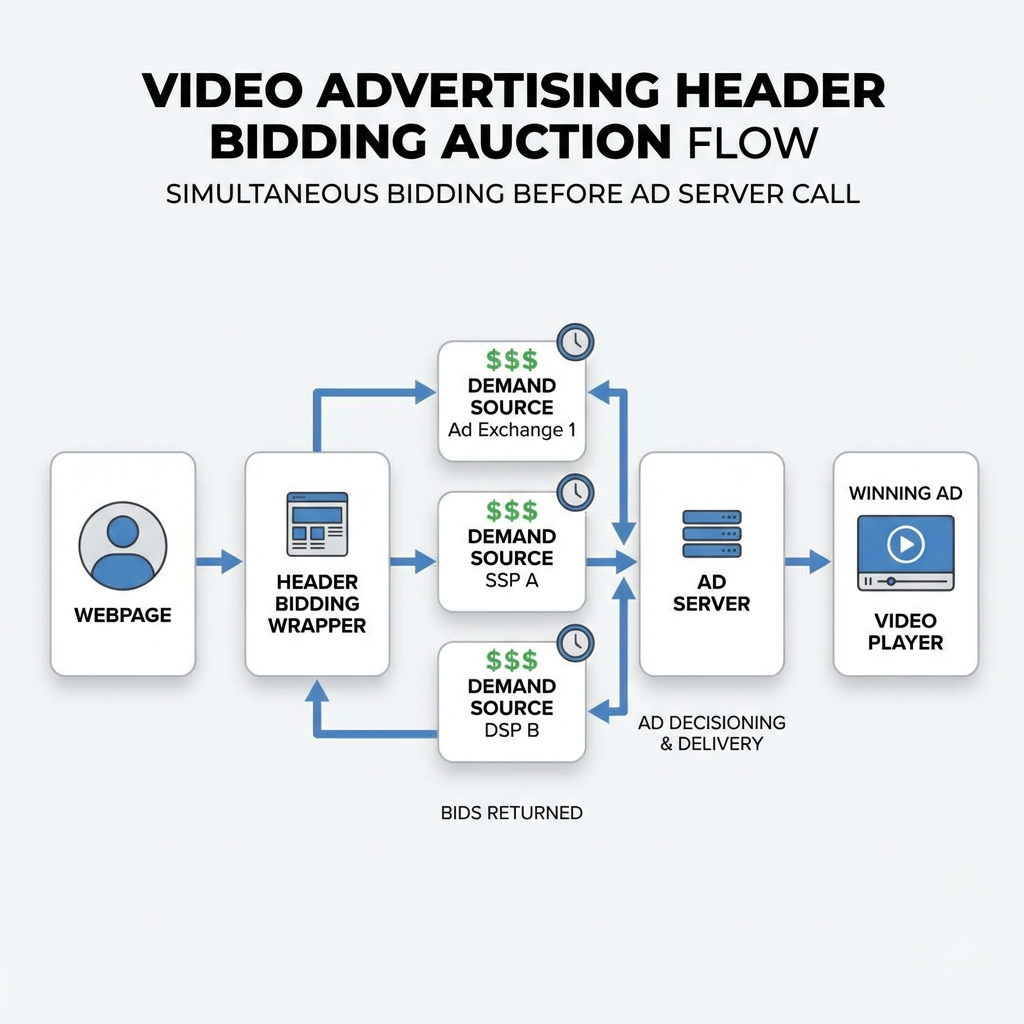
This client-side auction mechanism executes JavaScript code in the header of a webpage, allowing demand-side platforms (DSPs), supply-side platforms (SSPs), and ad exchanges to compete on equal footing. The highest bid wins the impression, regardless of the demand source, creating a more transparent and efficient marketplace for digital advertising inventory.
Types of Header Bidding Solutions
Client-Side Header Bidding
Client-side header bidding remains the most common implementation method. Publishers add JavaScript tags to their website headers, which trigger auction requests to multiple demand partners simultaneously. The winning bid is then passed to the ad server for final decisioning.
Advantages:
- Full control over auction mechanics
- Direct relationships with demand partners
- Transparency in bid responses and latency
- Easier debugging and optimization
Disadvantages:
- Increased page load times
- Browser timeout limitations
- Mobile performance challenges
- Complex wrapper management
Server-Side Header Bidding
Server-side solutions move the auction logic from the browser to external servers, reducing latency and improving page performance. Publishers send a single request to a server-side platform, which then conducts auctions with multiple demand sources.
Key benefits include:
- Reduced page latency
- Support for unlimited demand partners
- Better mobile performance
- Reduced browser resource consumption
Potential drawbacks:
- Less transparency in bid dynamics
- Dependency on third-party infrastructure
- Potential for reduced match rates
- Limited debugging capabilities
Hybrid Solutions
Many publishers adopt hybrid approaches, combining client-side and server-side elements to optimize performance while maintaining control over high-value demand sources. This strategy allows publishers to keep premium partners client-side while routing long-tail demand through server-side platforms.
Popular Header Bidding Platforms
Prebid.js
Prebid.js stands as the industry-leading open-source header bidding wrapper, powering header bidding implementations for thousands of publishers worldwide. Its transparent, community-driven development model has made it the de facto standard for client-side header bidding.
Core features:
- Support for 300+ demand partners
- Advanced auction analytics
- Price granularity controls
- User ID management
- Video and native ad support
Implementation example:
var adUnits = [{
  code: 'div-1',
  mediaTypes: {
    banner: {
      sizes: [[300, 250], [728, 90]]
    }
  },
  bids: [{
    bidder: 'appnexus',
    params: {
      placementId: 13144370
    }
  }]
}];
Amazon Transparent Ad Marketplace (TAM)
Amazon TAM provides publishers access to Amazon’s extensive advertiser demand through a server-side solution. The platform leverages Amazon’s first-party data and shopping insights to deliver competitive bids for display and video inventory.
Google Open Bidding
Formerly known as Exchange Bidding Dynamic Allocation (EBDA), Google Open Bidding allows demand partners to compete in real-time auctions alongside Google Ad Exchange. This server-side solution integrates directly with Google Ad Manager.
Index Exchange IX Library
Index Exchange offers both client-side and server-side header bidding solutions, with particular strength in video advertising. Their IX Library provides wrapper functionality with built-in optimization features.
Implementation Best Practices
Auction Configuration
Timeout Optimization: Set auction timeouts between 1000-2000 milliseconds to balance revenue opportunity with page performance. Test different timeout values to find the optimal setting for your traffic patterns.
Demand Partner Selection: Start with 8-12 high-quality demand partners rather than maximizing quantity. Focus on partners with strong match rates and competitive bid rates for your audience.
Price Granularity: Configure price buckets to capture meaningful bid differences. Use dense granularity ($0.01 increments) for high-value inventory and standard granularity for long-tail traffic.
Performance Optimization
Lazy Loading Implementation: Implement lazy loading for below-the-fold ad units to prevent unnecessary auction calls. This reduces server load and improves initial page load times.
Bid Caching: Utilize bid caching for single-page applications and video content where multiple ad calls occur within short timeframes. This prevents redundant auction calls and improves user experience.
Demand Partner Prioritization: Use s2s (server-to-server) connections for long-tail demand while keeping premium partners client-side for maximum transparency and control.
Quality Assurance
Auction Debugging: Implement comprehensive logging to monitor bid responses, auction outcomes, and revenue performance. Use tools like Prebid.js debugging console and browser developer tools.
A/B Testing Framework: Establish systematic testing procedures for new demand partners, configuration changes, and platform updates. Measure impact on revenue, latency, and user experience metrics.
Video Header Bidding Considerations
Video header bidding presents unique technical challenges and opportunities compared to display advertising. Publishers must navigate complex video ad standards while optimizing for higher-value inventory.
VAST and VPAID Integration
Video header bidding solutions must seamlessly integrate with existing video players and ad serving infrastructure. Ensure demand partners support VAST 4.0 standards and handle VPAID creatives appropriately.
Server-Side Ad Insertion (SSAI)
For streaming content and connected TV applications, server-side ad insertion becomes critical for seamless user experiences. Publishers should evaluate header bidding platforms that integrate with SSAI providers and support programmatic insertion of winning bids.
Video-focused publishers benefit from specialized solutions like Veedmo, which provides optimized video player technology that seamlessly integrates with header bidding implementations, ensuring smooth auction execution and ad rendering across devices.
Revenue Optimization Strategies
Dynamic Price Floors
Implement dynamic price floors that adjust based on historical performance data, user segments, and market conditions. Use machine learning algorithms to optimize floor prices across different inventory types and user contexts.
Floor price strategy examples:
- Geographic segmentation (premium markets vs. developing regions)
- Device type optimization (desktop vs. mobile vs. tablet)
- Time-based adjustments (peak vs. off-peak hours)
- Content category premiums (finance vs. general interest)
Demand Path Optimization (DPO)
Analyze bid stream data to identify and eliminate redundant demand sources. Focus on partners that provide unique demand rather than reselling inventory from common exchanges.
First-Party Data Integration
Leverage first-party audience data to create premium inventory segments. Pass relevant audience signals to demand partners while respecting privacy regulations and user consent preferences.
Technical Integration Challenges
Latency Management
Header bidding inherently adds latency to ad serving workflows. Publishers must balance auction completeness with page performance through strategic timeout management and progressive auction loading.
Latency optimization techniques:
- Implement progressive timeouts for different demand tiers
- Use parallel auction execution where possible
- Optimize JavaScript loading and execution order
- Monitor and alert on unusual latency spikes
Cookie Synchronization
Effective user matching between publishers and demand partners requires robust cookie synchronization strategies. Implement controlled cookie sync procedures that balance match rate improvement with privacy compliance.
Ad Quality Control
Establish comprehensive ad quality standards and monitoring systems. Implement real-time creative scanning, landing page verification, and performance monitoring to maintain user experience standards.
Privacy and Compliance Considerations
GDPR and CCPA Implementation
Header bidding implementations must comply with evolving privacy regulations. Ensure consent management platforms (CMPs) properly integrate with header bidding wrappers and that bid requests include appropriate consent signals.
Third-Party Cookie Deprecation
Prepare for the phase-out of third-party cookies by implementing alternative identity solutions. Evaluate universal ID solutions, contextual targeting capabilities, and first-party data strategies.
Measurement and Analytics
Key Performance Indicators
Monitor essential metrics to evaluate header bidding performance:
Revenue Metrics:
- eCPM improvement vs. waterfall setup
- Fill rate optimization across demand sources
- Revenue per thousand sessions (RPS)
Technical Performance:
- Average auction completion time
- Bid response rates by partner
- Page load impact measurement
Quality Metrics:
- Ad viewability rates
- Invalid traffic detection
- User engagement impact
Reporting Infrastructure
Develop comprehensive reporting systems that provide visibility into auction dynamics, demand partner performance, and revenue attribution. Use data visualization tools to identify optimization opportunities and performance trends.
Future-Proofing Your Header Bidding Strategy
Emerging Technologies
Connected TV (CTV) Integration: Prepare for CTV header bidding by evaluating platforms that support video advertising standards and streaming media integration.
5G and Edge Computing: Consider how improved network speeds and edge computing capabilities might enable more sophisticated auction mechanisms and real-time optimization.
Machine Learning Integration: Implement AI-powered bid optimization, fraud detection, and audience segmentation to maintain competitive advantages.
Industry Evolution
Stay informed about industry developments including new privacy regulations, advertising standards updates, and platform policy changes. Participate in industry organizations and maintain relationships with technology vendors to ensure access to beta features and strategic guidance.
Conclusion
Header bidding solutions continue evolving to address publisher needs for revenue optimization, technical performance, and regulatory compliance. Success requires strategic platform selection, careful implementation, and ongoing optimization based on performance data.
Publishers should focus on establishing solid technical foundations, maintaining high ad quality standards, and preparing for industry changes including privacy regulation evolution and new advertising formats. Regular testing, measurement, and optimization ensure header bidding implementations deliver sustainable revenue growth while maintaining positive user experiences.
The future of header bidding lies in intelligent automation, improved privacy compliance, and seamless integration across all digital advertising channels. Publishers who invest in comprehensive strategies and maintain technical excellence will be best positioned to capitalize on programmatic advertising opportunities.