What is Google Header Bidding?
Google header bidding represents a sophisticated programmatic advertising approach that enables publishers to offer their ad inventory to multiple demand sources simultaneously before making calls to their primary ad server. Unlike traditional waterfall setups where ad requests are processed sequentially, header bidding creates a unified auction environment where Google Ad Manager (GAM), Google AdX, and third-party demand sources can compete in real-time for the same impression.
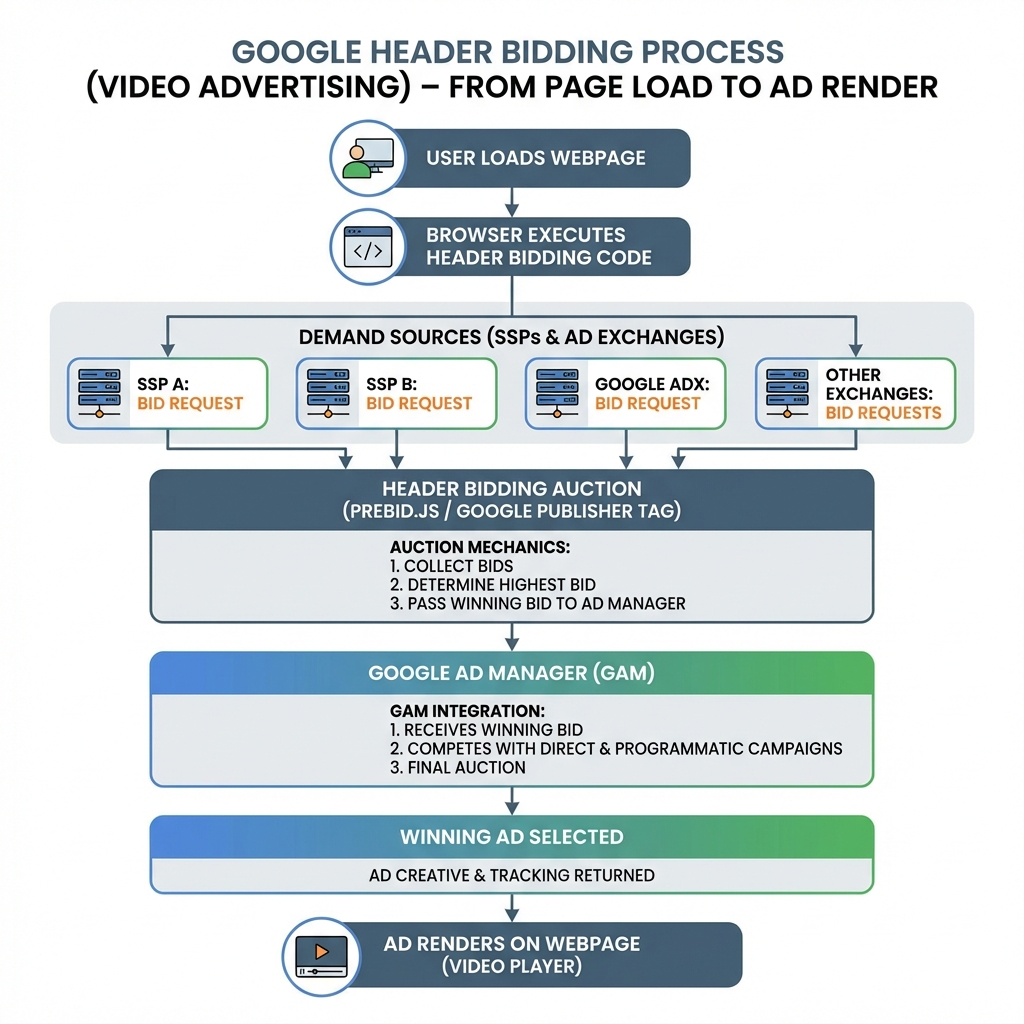
This approach fundamentally transforms how publishers monetize their inventory by ensuring that the highest-paying advertiser wins each impression, regardless of whether they’re part of Google’s ecosystem or external demand sources. For publishers, this typically translates to increased revenue, better fill rates, and more transparent auction dynamics.
How Google Header Bidding Works
The Technical Process
Google header bidding operates through a client-side implementation that executes before the primary ad server call. Here’s the step-by-step process:
- Page Load Initialization: When a user visits a publisher’s page, the header bidding wrapper (typically Prebid.js or Google Publisher Tag) loads in the page header
- Simultaneous Bid Requests: The wrapper sends bid requests to all configured demand partners, including Google AdX and other SSPs
- Bid Collection: All demand sources return their bids within a predetermined timeout period (usually 1000-2000ms)
- Price Competition: Bids are collected and the highest bid is identified
- Ad Server Call: The winning bid price is passed to Google Ad Manager as a key-value pair
- Final Auction: GAM conducts its internal auction, comparing the header bidding winner against direct campaigns and other line items
- Ad Rendering: The highest-paying creative is selected and rendered
Google’s Unique Position
Google offers both server-side and client-side header bidding solutions. Google AdX can participate in header bidding through Exchange Bidding in Ad Manager (EBDA) or through client-side integrations. This dual approach allows Google to maintain competitive positioning while providing publishers with flexibility in their implementation strategies.
Implementation Strategies for Publishers
Client-Side Implementation
Client-side header bidding remains the most common implementation method for Google integrations. Publishers typically use Prebid.js as their wrapper solution:
// Basic Prebid.js configuration with Google AdX
var adUnits = [{
  code: 'header-banner-ad',
  mediaTypes: {
    banner: {
      sizes: [[728, 90], [970, 250]]
    }
  },
  bids: [{
    bidder: 'appnexus',
    params: {
      placementId: 13144370
    }
  }, {
    bidder: 'rubicon',
    params: {
      accountId: 14062,
      siteId: 70608,
      zoneId: 335918
    }
  }]
}];
Server-Side Solutions
Google’s Ad Manager also supports server-side header bidding through Open Bidding (formerly Exchange Bidding in Dynamic Allocation). This approach reduces page latency by moving the auction logic to Google’s servers:
- Reduced Latency: Server-side processing eliminates client-side JavaScript execution delays
- Simplified Management: Publishers manage fewer direct integrations
- Enhanced Reporting: Unified reporting through Google Ad Manager interface
Hybrid Approaches
Many sophisticated publishers implement hybrid setups combining both client-side and server-side elements:
- Premium Partners: High-value demand partners remain client-side for maximum transparency
- Long-Tail Demand: Smaller partners participate through server-side integrations
- Video Inventory: Video ads often require specialized handling through solutions like Veedmo for optimal player integration and header bidding compatibility
Optimization Best Practices
Timeout Management
Optimal timeout settings balance revenue potential against user experience:
- Desktop: 1500-2000ms typically optimal
- Mobile: 1000-1500ms recommended due to slower connections
- Video: 3000-5000ms acceptable due to higher CPMs
Price Granularity Configuration
Google Ad Manager supports various price granularity settings that directly impact header bidding effectiveness:
// Dense price granularity for premium inventory
pbjs.setConfig({
  priceGranularity: {
    buckets: [{
      precision: 2,
      min: 0,
      max: 20,
      increment: 0.10
    }, {
      precision: 2,
      min: 20,
      max: 50,
      increment: 0.50
    }]
  }
});
Demand Partner Selection
Successful Google header bidding implementations require strategic demand partner curation:
- Geographic Coverage: Ensure partners provide relevant demand for your audience locations
- Category Alignment: Select partners with advertiser bases matching your content categories
- Technical Compatibility: Verify partners support your required ad formats and sizes
- Performance History: Analyze historical bid rates, win rates, and revenue contribution
Revenue Impact and Performance Metrics
Key Performance Indicators
Publishers should monitor several critical metrics when evaluating Google header bidding performance:
Revenue Metrics:
- RPM (Revenue per Thousand Impressions) improvement
- Fill rate optimization
- eCPM trends across demand sources
- Bid density and competition levels
Technical Metrics:
- Page load time impact
- Timeout rates by partner
- Bid response times
- Error rates and debugging logs
Expected Revenue Improvements
Industry benchmarks suggest publishers typically see:
- 10-40% revenue increase in the first 90 days post-implementation
- Improved fill rates of 5-15% through increased competition
- Better price discovery leading to higher average CPMs
- Reduced ad server discrepancy through improved auction mechanics
Common Implementation Challenges
Technical Integration Issues
JavaScript Conflicts: Header bidding implementations can conflict with existing page JavaScript, requiring careful testing and debugging.
Ad Server Configuration: Google Ad Manager line item setup requires precise targeting and pricing configurations to ensure header bidding winners are properly recognized.
Mobile Implementation: Mobile environments present unique challenges including:
- Limited processing power affecting timeout tolerances
- Network variability impacting bid response consistency
- App vs. web implementation differences
Troubleshooting Common Problems
Low Bid Participation:
- Verify demand partner configurations
- Check geographic and categorical targeting settings
- Review inventory quality scores and brand safety compliance
Revenue Drops:
- Analyze timeout settings impact on bid participation
- Review price granularity configurations
- Investigate ad server line item competition logic
Page Performance Issues:
- Implement asynchronous loading patterns
- Optimize timeout values for user experience balance
- Consider server-side alternatives for performance-critical pages
Advanced Configuration Techniques
Dynamic Timeout Management
Sophisticated publishers implement device and connection-aware timeout logic:
// Dynamic timeout based on connection type
function getOptimalTimeout() {
  const connection = navigator.connection;
  if (connection) {
    switch(connection.effectiveType) {
      case '4g': return 2000;
      case '3g': return 1500;
      case '2g': return 1000;
      default: return 1500;
    }
  }
  return 1500; // fallback
}
A/B Testing Frameworks
Continuous optimization requires systematic testing:
- Timeout Variations: Test different timeout values across user segments
- Partner Mix Testing: Evaluate optimal demand partner combinations
- Price Granularity Experiments: Test various granularity settings impact
- Implementation Method Comparison: Compare client-side vs. server-side performance
Advanced Targeting Integration
Google header bidding can leverage sophisticated audience targeting:
- First-Party Data Integration: Pass publisher audience segments to demand partners
- Contextual Targeting: Enhance bids with page content analysis
- Behavioral Targeting: Utilize user browsing history for improved bid relevance
Future Considerations and Industry Trends
Privacy-First Adaptations
The evolving privacy landscape significantly impacts header bidding strategies:
Third-Party Cookie Deprecation: Publishers must adapt header bidding setups to function effectively in cookieless environments, leveraging:
- First-party data strategies
- Contextual targeting enhancements
- Privacy-preserving audience solutions
Consent Management Integration: GDPR and CCPA compliance requires header bidding implementations to respect user consent preferences and adjust demand partner participation accordingly.
Emerging Technologies
Server-Side Evolution: Continued improvement in server-side solutions addresses traditional client-side limitations while maintaining auction transparency.
Machine Learning Integration: AI-powered optimization tools increasingly automate timeout management, partner selection, and price granularity decisions.
Video and CTV Growth: Connected TV and video inventory monetization through header bidding continues expanding, requiring specialized implementation approaches.
Measuring Success and ROI
Performance Benchmarking
Establishing pre-implementation baselines enables accurate ROI measurement:
- Historical Revenue Analysis: 90-day pre-implementation revenue averages
- Fill Rate Documentation: Existing ad server fill rate performance
- User Experience Metrics: Page load times and engagement rates
- Operational Costs: Current ad operations team time allocation
Long-Term Optimization Strategy
Successful Google header bidding implementations require ongoing optimization:
Monthly Reviews:
- Demand partner performance analysis
- Timeout optimization based on performance data
- Revenue trend analysis and forecasting
- Technical performance monitoring
Quarterly Strategic Assessments:
- Market condition adaptations
- New demand partner evaluations
- Implementation technology updates
- Competitive landscape analysis
Google header bidding represents a critical component of modern publisher monetization strategies. When implemented thoughtfully with proper optimization and ongoing management, it delivers significant revenue improvements while maintaining positive user experiences. Success requires balancing technical implementation excellence with strategic demand partner management and continuous performance optimization.
The key to maximizing Google header bidding effectiveness lies in understanding that it’s not a set-and-forget solution, but rather an ongoing optimization opportunity that requires dedicated attention, systematic testing, and adaptation to changing market conditions. Publishers who invest in proper implementation and management typically see sustained revenue improvements that justify the initial technical investment and ongoing operational requirements.