What is a Video Ad Exchange?
A video ad exchange is a digital marketplace where publishers and advertisers buy and sell video advertising inventory through real-time bidding (RTB) auctions. These automated platforms connect supply-side platforms (SSPs) representing publishers with demand-side platforms (DSPs) representing advertisers, enabling programmatic transactions for video ad placements across websites, mobile apps, and connected TV (CTV) environments.
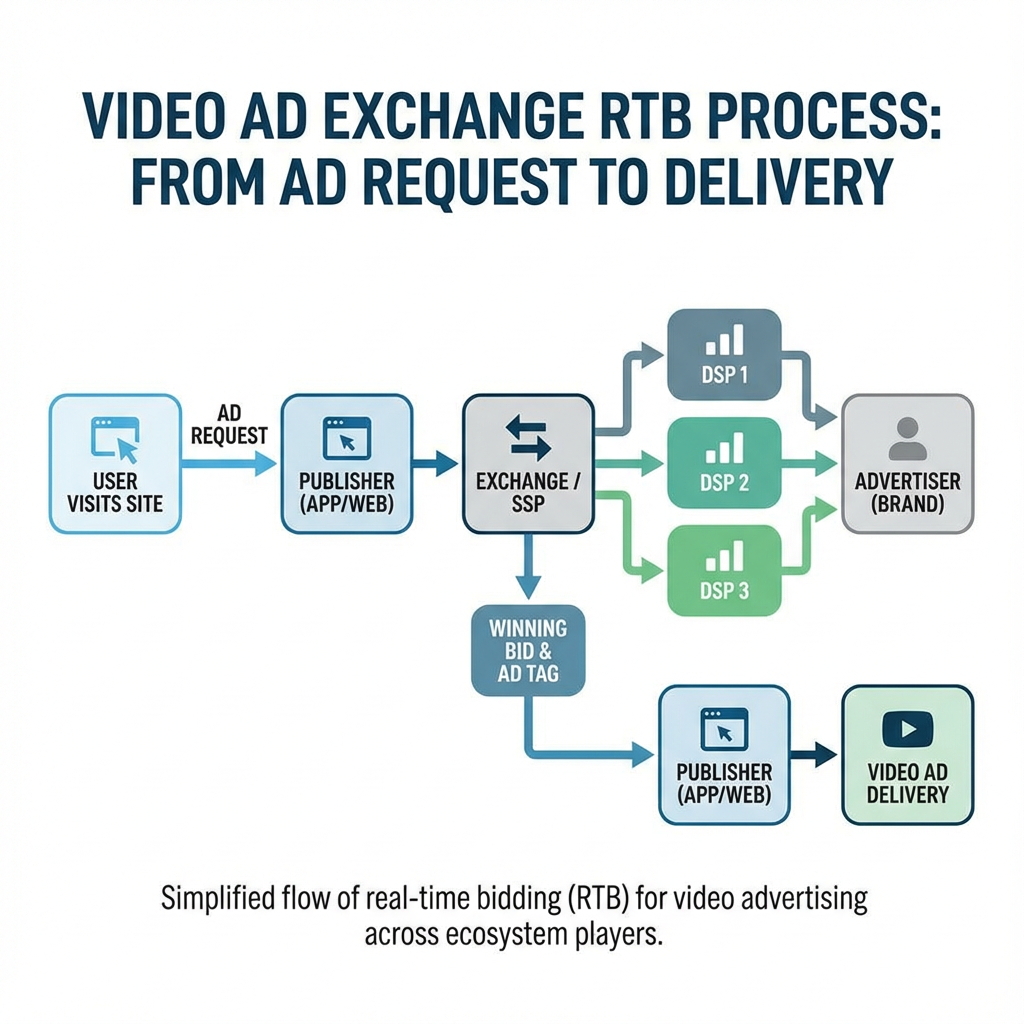
Video ad exchanges have revolutionized the digital advertising ecosystem by providing transparency, efficiency, and scale that traditional direct sales models couldn’t match. For publishers, they offer access to a global pool of advertisers competing for their inventory, while advertisers gain access to premium video placements with precise targeting capabilities.
How Video Ad Exchanges Work
The Real-Time Bidding Process
When a user visits a webpage or opens an app with video ad inventory, the following process occurs within milliseconds:
- Ad Request: The publisher’s ad server sends a bid request to the video ad exchange
- Auction Setup: The exchange analyzes the request and available inventory
- Bidder Notification: Multiple DSPs receive the bid request simultaneously
- Bid Submission: Advertisers submit bids based on their targeting criteria and budget
- Winner Selection: The highest bid wins the auction
- Ad Delivery: The winning creative is served to the user
This entire process typically completes in under 100 milliseconds, ensuring minimal impact on user experience.
Key Components of Video Ad Exchanges
Supply-Side Integration: Publishers integrate with video ad exchanges through SSPs or directly via APIs. The integration typically involves implementing industry-standard protocols like VAST (Video Ad Serving Template) for ad serving and VMAP (Video Multiple Ad Playlist) for ad scheduling.
Demand-Side Connectivity: Advertisers and agencies access inventory through DSPs that connect to multiple exchanges, providing campaign management tools and optimization algorithms.
Data Management: Advanced video ad exchanges incorporate first-party and third-party data to enhance targeting capabilities, including demographic, behavioral, and contextual signals.
Benefits for Publishers
Revenue Optimization
Video ad exchanges enable publishers to maximize revenue through several mechanisms:
Competitive Bidding: Multiple advertisers compete for the same inventory, driving up prices through market dynamics. Publishers often see 15-30% revenue increases compared to direct sales alone.
Dynamic Pricing: Unlike fixed-rate direct deals, exchange pricing fluctuates based on real-time demand, allowing publishers to capture premium rates during high-demand periods.
Fill Rate Improvement: Exchanges help publishers monetize previously unsold inventory by providing access to a broader advertiser base, often achieving fill rates above 90%.
Operational Efficiency
Programmatic video advertising through exchanges reduces operational overhead:
Automated Sales Process: No need for manual insertion orders or campaign trafficking Real-time Reporting: Immediate access to performance data and revenue metrics Reduced Administrative Tasks: Less time spent on campaign setup and optimization
Access to Premium Demand
Video ad exchanges connect publishers with high-quality advertisers they might not reach through direct sales efforts. This includes international brands, performance marketers, and agencies managing large programmatic budgets.
Types of Video Ad Exchanges
Open Exchanges
Open exchanges are public marketplaces where any qualified buyer can participate. Examples include Google Ad Exchange, OpenX, and PubMatic. These platforms offer maximum reach and competition but may have less control over advertiser quality.
Advantages:
- Highest potential revenue due to maximum competition
- Largest pool of advertisers
- Minimal setup requirements
Considerations:
- Less control over ad quality
- Potential for lower-value advertisers
- Brand safety concerns
Private Marketplaces (PMPs)
Private marketplaces are invitation-only auctions where publishers control which advertisers can bid on their inventory. This model combines programmatic efficiency with the quality control of direct sales.
Use Cases:
- Premium publishers seeking brand-safe environments
- Publishers with specific audience segments
- Campaigns requiring content adjacency guarantees
Preferred Deals
Preferred deals allow publishers to offer inventory to specific advertisers at negotiated prices before it enters the open auction. This hybrid approach maintains relationships with key advertisers while capturing programmatic efficiencies.
Implementation Best Practices
Technical Integration
VAST Compliance: Ensure your video player supports VAST 4.0+ for maximum advertiser compatibility. Modern video solutions like Veedmo provide built-in VAST support and optimization features that enhance exchange performance.
Header Bidding Implementation: Implement header bidding for video inventory to increase competition and revenue. This technique allows multiple exchanges to bid simultaneously before your primary ad server makes a decision.
Ad Pod Configuration: For longer-form content, configure ad pods properly to maximize revenue from pre-roll, mid-roll, and post-roll placements while maintaining user experience.
Inventory Management
Floor Price Optimization: Set dynamic floor prices based on historical performance data. Use A/B testing to find optimal floor prices that maximize revenue without significantly impacting fill rates.
Targeting Parameters: Provide rich metadata about your content and audience to enable better advertiser targeting. This includes content categories, user demographics (where privacy-compliant), and contextual information.
Inventory Segmentation: Create different inventory packages for different buyer types. Premium inventory can be reserved for PMPs while standard inventory flows through open exchanges.
Performance Monitoring
Key Performance Indicators (KPIs):
- eCPM (Effective Cost Per Mille): Average revenue per thousand impressions
- Fill Rate: Percentage of ad requests that receive ads
- Viewability Rate: Percentage of ads that meet viewability standards
- Completion Rate: Percentage of video ads played to completion
- Latency: Time from ad request to ad start
Optimization Strategies:
- Monitor performance by exchange and adjust traffic allocation accordingly
- Implement frequency capping to improve user experience
- Optimize ad formats and durations based on performance data
- Conduct regular audits of advertiser quality and brand safety
Challenges and Solutions
Ad Quality and Brand Safety
Challenge: Maintaining ad quality standards while maximizing revenue through automated buying.
Solutions:
- Implement robust advertiser verification systems
- Use third-party brand safety tools
- Create whitelists and blacklists for advertiser categories
- Regular manual review of served advertisements
Technical Complexity
Challenge: Managing multiple exchange integrations and optimization requirements.
Solutions:
- Partner with experienced SSPs that handle technical complexities
- Invest in ad ops team training and tools
- Implement comprehensive monitoring and alerting systems
- Regular performance reviews and optimization cycles
Competition Management
Challenge: Balancing multiple revenue sources without cannibalizing direct sales.
Solutions:
- Implement proper inventory allocation strategies
- Use unified auction technology when possible
- Maintain clear communication between direct and programmatic sales teams
- Regular analysis of revenue attribution across channels
Future Trends in Video Ad Exchanges
Connected TV (CTV) Growth
The rapid adoption of streaming services has created massive opportunities in CTV advertising. Video ad exchanges are evolving to handle the unique requirements of CTV inventory, including longer ad formats, household-level targeting, and cross-device measurement.
Privacy-First Advertising
With the deprecation of third-party cookies and increasing privacy regulations, video ad exchanges are investing in privacy-preserving technologies like contextual targeting, first-party data activation, and privacy-safe audience segments.
Advanced Measurement and Attribution
New measurement technologies are enabling better attribution and ROI calculation for video campaigns. This includes view-through attribution, cross-device tracking, and integration with offline sales data.
Artificial Intelligence and Machine Learning
AI-powered optimization is becoming standard in video ad exchanges, enabling:
- Predictive pricing algorithms
- Automated creative optimization
- Fraud detection and prevention
- Real-time audience segmentation
Choosing the Right Video Ad Exchange
Evaluation Criteria
Revenue Potential:
- Historical eCPM performance
- Advertiser demand quality
- Geographic coverage
- Vertical specialization
Technical Capabilities:
- VAST/VPAID support levels
- Header bidding compatibility
- Reporting and analytics depth
- Integration complexity
Support and Service:
- Account management quality
- Technical support responsiveness
- Training and educational resources
- Optimization recommendations
Testing and Optimization
Implement a systematic testing approach:
- Pilot Testing: Start with a small percentage of inventory
- Performance Comparison: Compare against existing revenue sources
- Gradual Scaling: Increase allocation based on performance
- Continuous Monitoring: Regular performance reviews and adjustments
Conclusion
Video ad exchanges represent a crucial component of modern digital advertising infrastructure, offering publishers unprecedented access to global advertising demand while providing the automation and efficiency needed to compete in today’s fast-paced digital landscape.
Success with video ad exchanges requires careful planning, technical expertise, and ongoing optimization. Publishers who invest in proper implementation, monitoring, and optimization can expect significant revenue improvements and operational efficiencies.
The future of video advertising will be increasingly programmatic, with exchanges evolving to support new formats, privacy requirements, and measurement standards. Publishers who establish strong programmatic foundations today will be well-positioned to capitalize on these future opportunities.
By following the best practices outlined in this guide and maintaining a data-driven approach to optimization, publishers can maximize the value of their video inventory while delivering high-quality advertising experiences to their audiences.